
Axiomyx Arena
A self-learning tactical opponent for complex games
Axiomyx Arena
Practice, experiment and analyse against an opponent that learns from experience instead of following a fixed script.
What Arena is
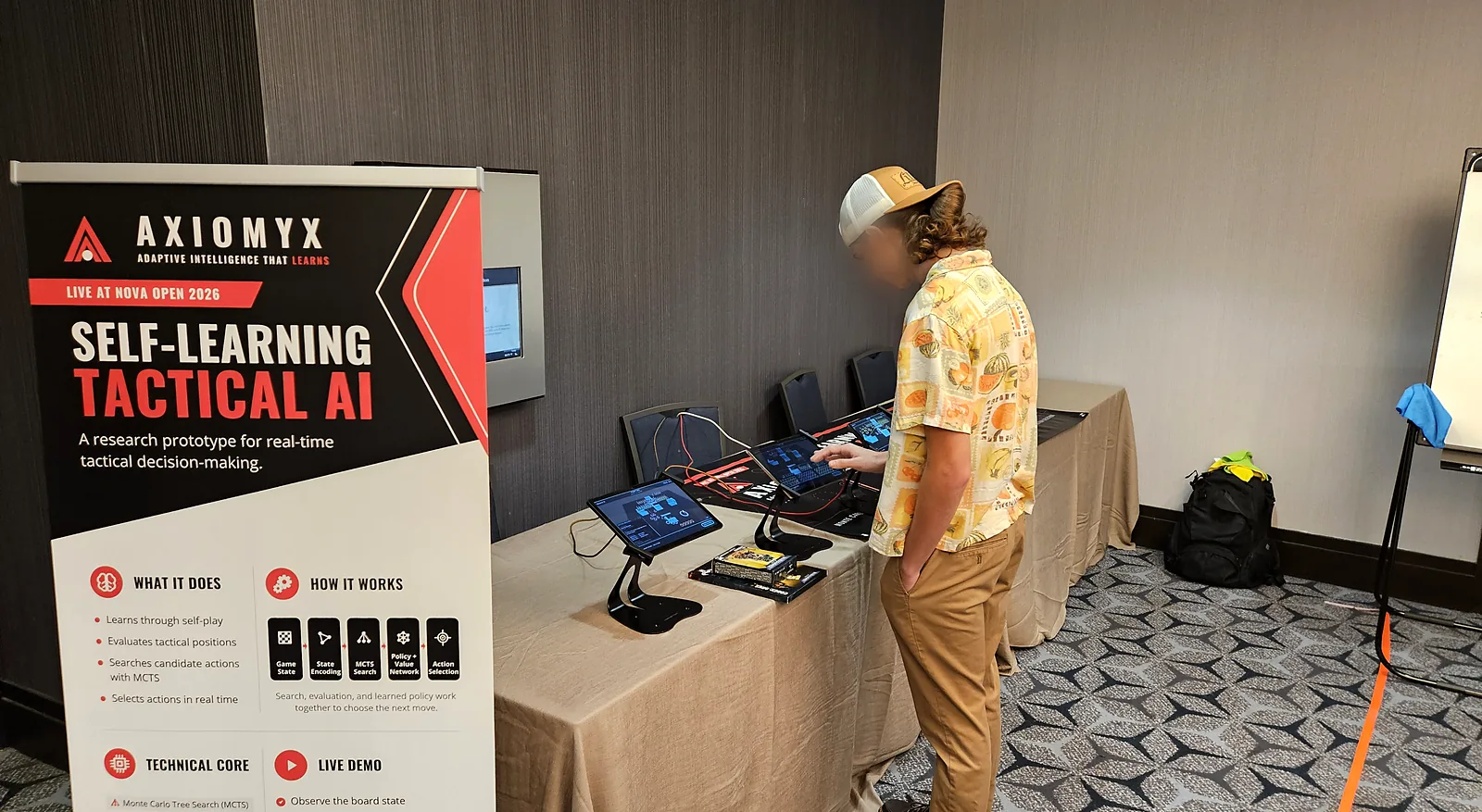
Axiomyx Arena is the gaming-facing implementation of the Axiomyx decision platform. It places an adaptive agent inside a structured game environment, where it reads the current game state, works out which of the legal actions are worth examining, searches possible futures, and plays a move. Then it does that again, for a whole game.
This is not a chatbot reading a rulebook and describing what it would do. There is no prose in the loop. The agent operates on an encoded representation of the game state and on an enumerated set of legal actions, and its decisions are selected by search against a learned evaluation. That distinction matters, because it is what makes the decisions repeatable, measurable and reviewable rather than plausible-sounding.
What it does in a game
- Interprets the current game state
- Enumerates and evaluates legal actions
- Searches possible futures before committing
- Selects and plays tactical actions under a time budget
- Plays complete games, not isolated puzzle positions
- Produces repeatable practice against the same situation
- Records every decision so human and machine choices can be compared
The problem it solves
Getting better at a complex game needs opposition, and opposition is the part that is hardest to find. A regular opponent is not always available. A strong one is available less often. Neither of them wants to replay the same awkward deployment eleven times so you can work out what you keep getting wrong.
Arena is built for that gap: an opponent that is always available, plays the whole game, and leaves a record behind.
Who it is for
Four different reasons to want an opponent that never leaves.
Players
Get more reps
- Practise when another player is not available
- Play outside club hours, at your own pace
- Repeat a matchup until it stops surprising you
- Train against decision patterns you do not normally face
Competitive players
Work on specific problems
- Replay difficult situations rather than whole games
- Repeat deployment and opening turn scenarios
- Stress-test a tactical choice against an opponent that responds
- Review the alternatives you did not take
Coaches and clubs
Build repeatable training
- Set up fixed tactical challenges everyone can attempt
- Compare an expert's decision with the machine's on the same state
- Use Axiomyx as a persistent sparring partner between sessions
- Run the same exercise across a group and compare results
Game developers
Longer term
- Integrate an adaptive tactical opponent into a supported structured environment
- Use recorded decision telemetry for balance and analysis work
- There is no SDK or integration programme today. This is a direction, not an offer, and it is listed here so it is not mistaken for one
How Arena works
One move, start to finish.
Every decision in a game goes through the same loop. The interesting part is step four, because that is where the system spends its time budget deciding rather than guessing.
- Game stateThe board, the units, the objectives, the round and the phase, encoded as structured numbers rather than described in words.
- Legal actionsEverything the rules permit from here is enumerated. The agent chooses from that set, so an illegal move is not something it can play.
- Neural evaluationA trained network estimates how good this position is, and which of the legal actions look promising enough to be worth searching. This is what stops the search wasting its budget on the obviously bad options.
- Monte Carlo Tree SearchPromising actions are played forward, and the positions they lead to are evaluated in turn. Better-looking lines get explored more deeply. The search builds up a picture of which action actually tends to end well, rather than which one looks best right now.
- Selected actionThe action the search has most confidence in is played, within the time the environment allows. At Nova that averaged about 350 ms.
- Updated game stateThe move is applied, the opponent responds, and the new state becomes the starting point for the next decision.
- ContinueRepeat until the game ends. A completed game at Nova ran to roughly 47 machine decisions.
Search is not the system imagining what a human would do. It is a budgeted sampling process: expand a candidate line, evaluate where it leads, use that result to decide what to expand next. The learned evaluation is what makes a small budget worth more than a large random one.
Current and planned
What Arena is, and what it is becoming.
The line between these two columns is the most important thing on this page. Nothing in the planned column exists today.
| Capability | Status | Detail |
|---|---|---|
| Completes a full game against a human | Now | Demonstrated publicly at Nova Open 2026 across more than 80 recorded games |
| Legal tactical decisions in real time | Now | Around 350 ms per decision on tablet hardware at the event |
| Recorded games and replay | Now | Every Nova game was recorded and can be played back move by move |
| Decision telemetry | Now | Position value, search simulations, root visits, candidate actions and decision time are recorded where the build emits them |
| Stronger positional and sequencing play | In development | The clearest gap Nova exposed. See the case study |
| Selectable AI skill profiles | Planned | Not implemented |
| Fixed-state tactical challenges | Planned | Not implemented |
| Candidate action comparison for players | Planned | The telemetry exists; the player-facing analysis view does not |
| Expert benchmarking | Planned | Not implemented |
| Coaching tools and club installations | Planned | Not implemented |
| Remote or local play options | Planned | Not implemented |
| Game-specific environment adapters | Planned | Architecture work in progress. See the Engine page |
Proof
It already survived contact with real players.
Arena has passed the point that matters most: a player could sit down at a table and complete a highly complex game against an autonomous tactical agent, with no other human involved.
Most of those players won. The case study covers what the agent had learned, where its learning was clearly incomplete, and why players asked for access anyway.
Read the Nova Open 2026 case study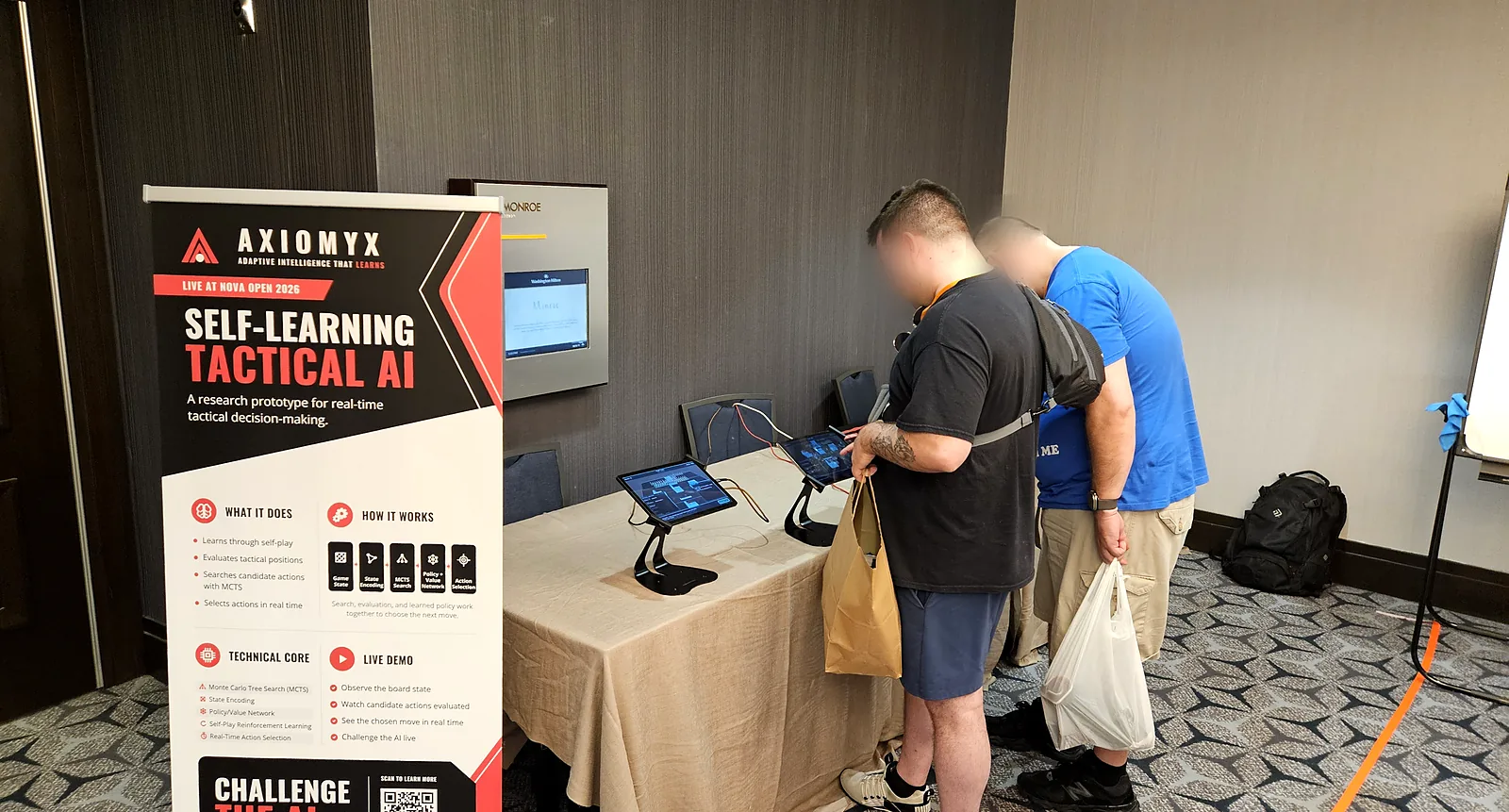
Want Arena when it is ready?
Register and pick Arena. The interest split is what decides which environment gets built out first, and it is the only list that gets told when a build is available.