
Axiomyx Nova Open 2026
Case study
Axiomyx at Nova Open 2026
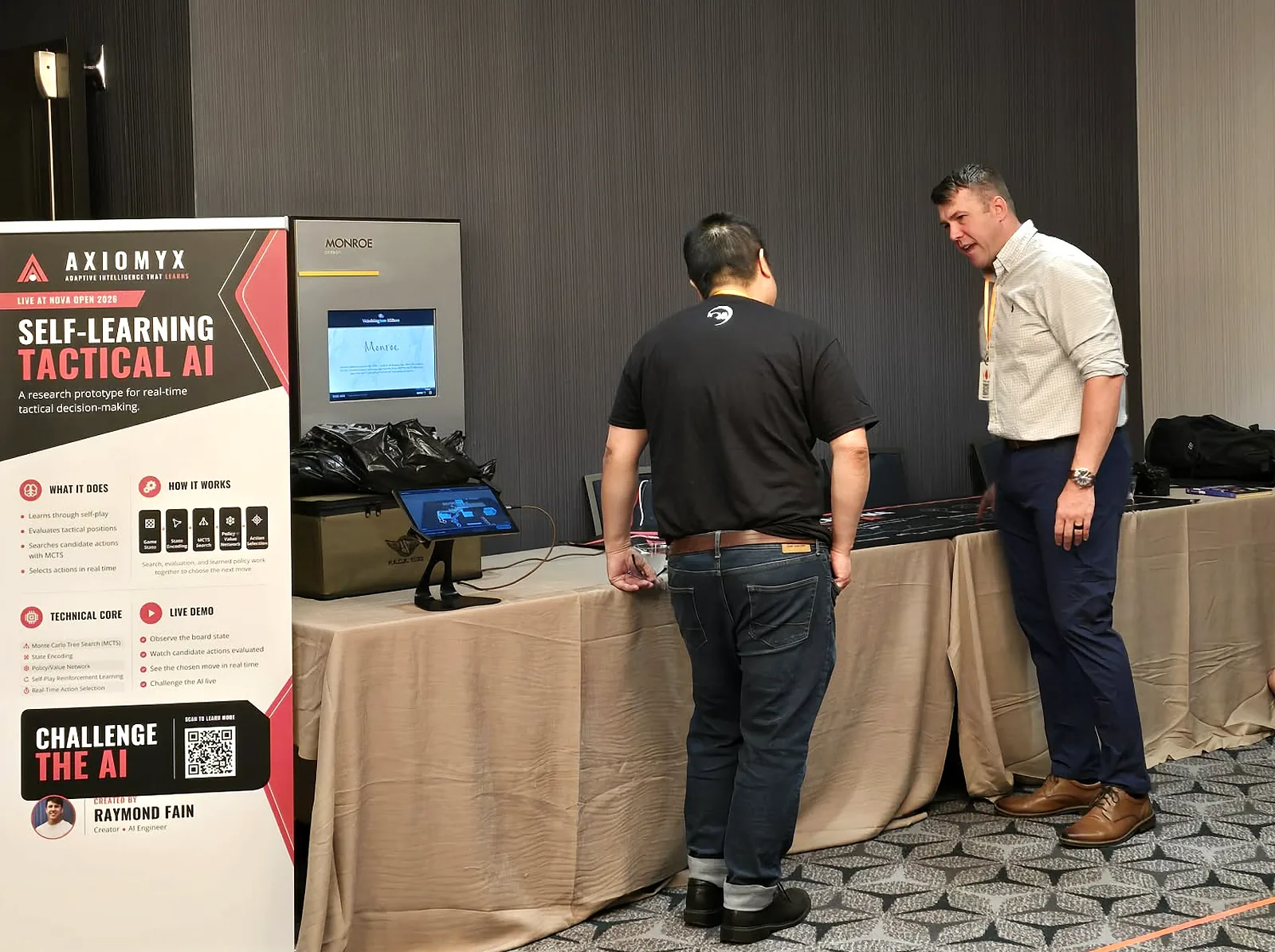
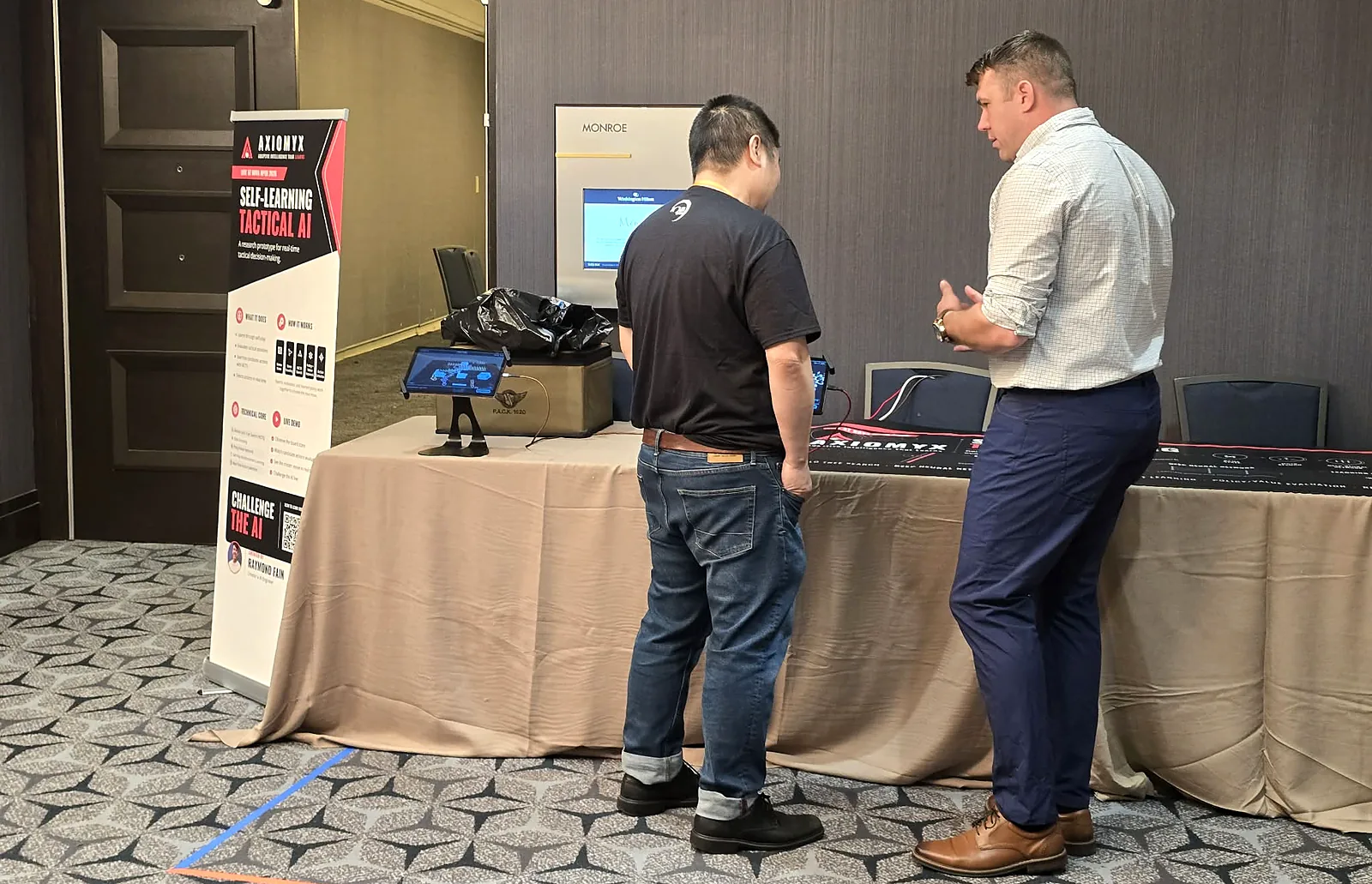
From training run to real table. Axiomyx was put in front of real players to answer one question: could a self-learning tactical agent make enough credible decisions to let someone sit down and play a complex tabletop game against it?
The answer was yes. Not that it played well, and not that it was finished. That it worked well enough to be played, which is what exposed everything else.
What the demonstration was for
The point was not to find out whether the machine could win. A hall full of experienced players is a bad place to go looking for a flattering scoreline, and it was never the question.
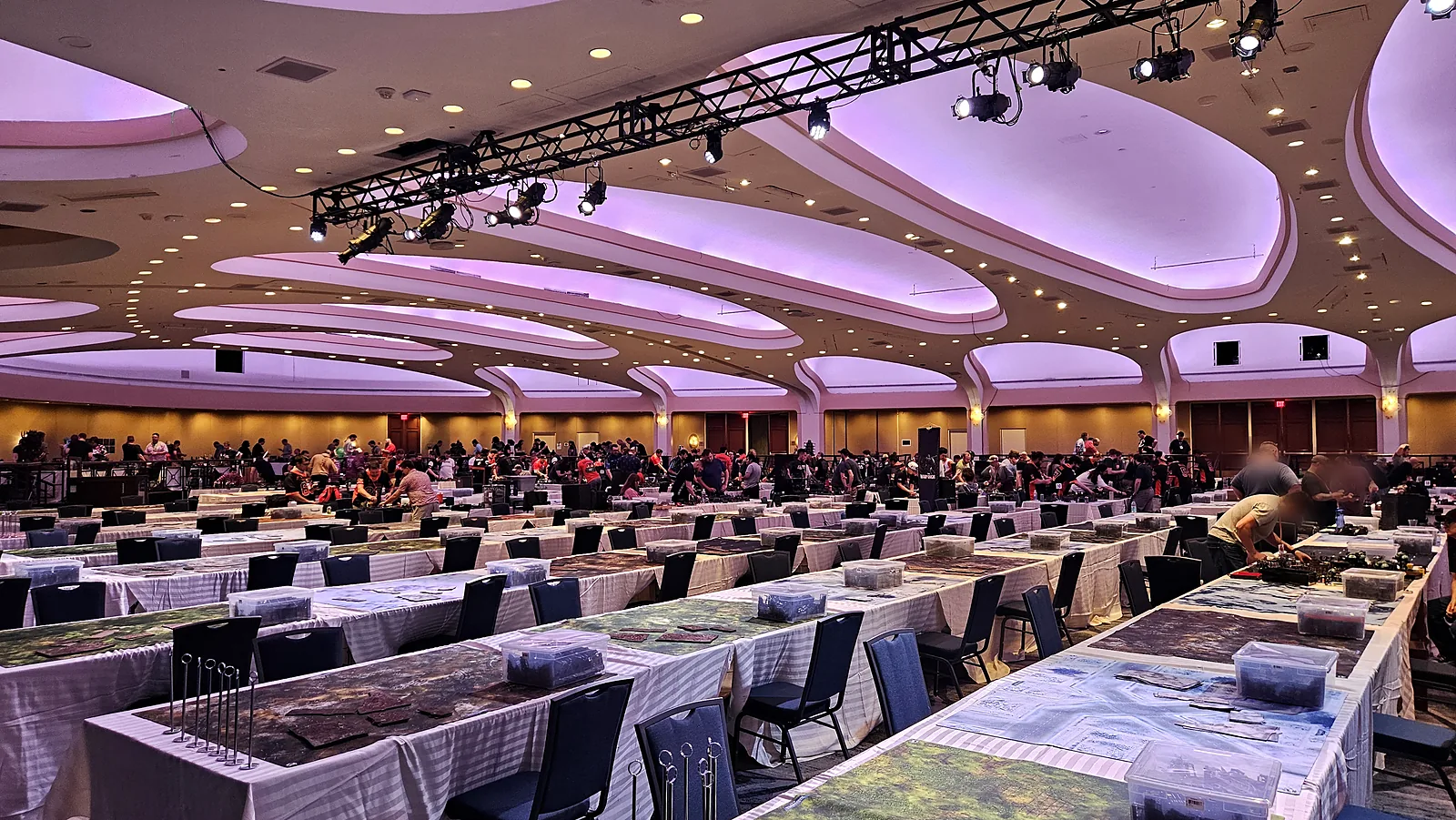
It was the first time the system had been played by people who were not building it, on hardware on a table, in real time, with no way to quietly restart a game that was going badly. That is a different test from a training run, and it answers different questions.
- How players actually behave when the opponent is a machine
- Whether the system produces tactical decisions a competent player finds credible
- Whether people would use something like this as a practice tool
- Where human and machine decision-making come apart, and which one is right when they do
Every game was recorded, with the decisions the agent made and the telemetry behind them, which is why there is something to write about rather than an impression.
The numbers
What can be said with confidence.
These come from the recorded games and the build's own decision telemetry. There is no win rate here, because the demonstration was not run in a way that would produce an honest one.
On the arithmetic. About 47 decisions at an average of about 350 ms is roughly 16 seconds of decision time. The measured total across a completed game is closer to 20 seconds. The gap is real and it is not rounding: the per-decision average covers the search itself, while the whole-game total also carries state encoding, model inference setup and the handling around each decision. Both numbers are reported as measured rather than reconciled to each other, because making them agree would mean changing one of them.
On the search figure. The replay format records
mcts_simulations against individual decisions, alongside root visits, estimated state
value and the top candidate actions. The 700+ figure is a floor for a completed game rather than a
per-decision budget. Decision counts and timings both vary with game length and with phase, since a
movement decision and a command decision are not the same amount of work.
Player experience
What people actually met across the table.
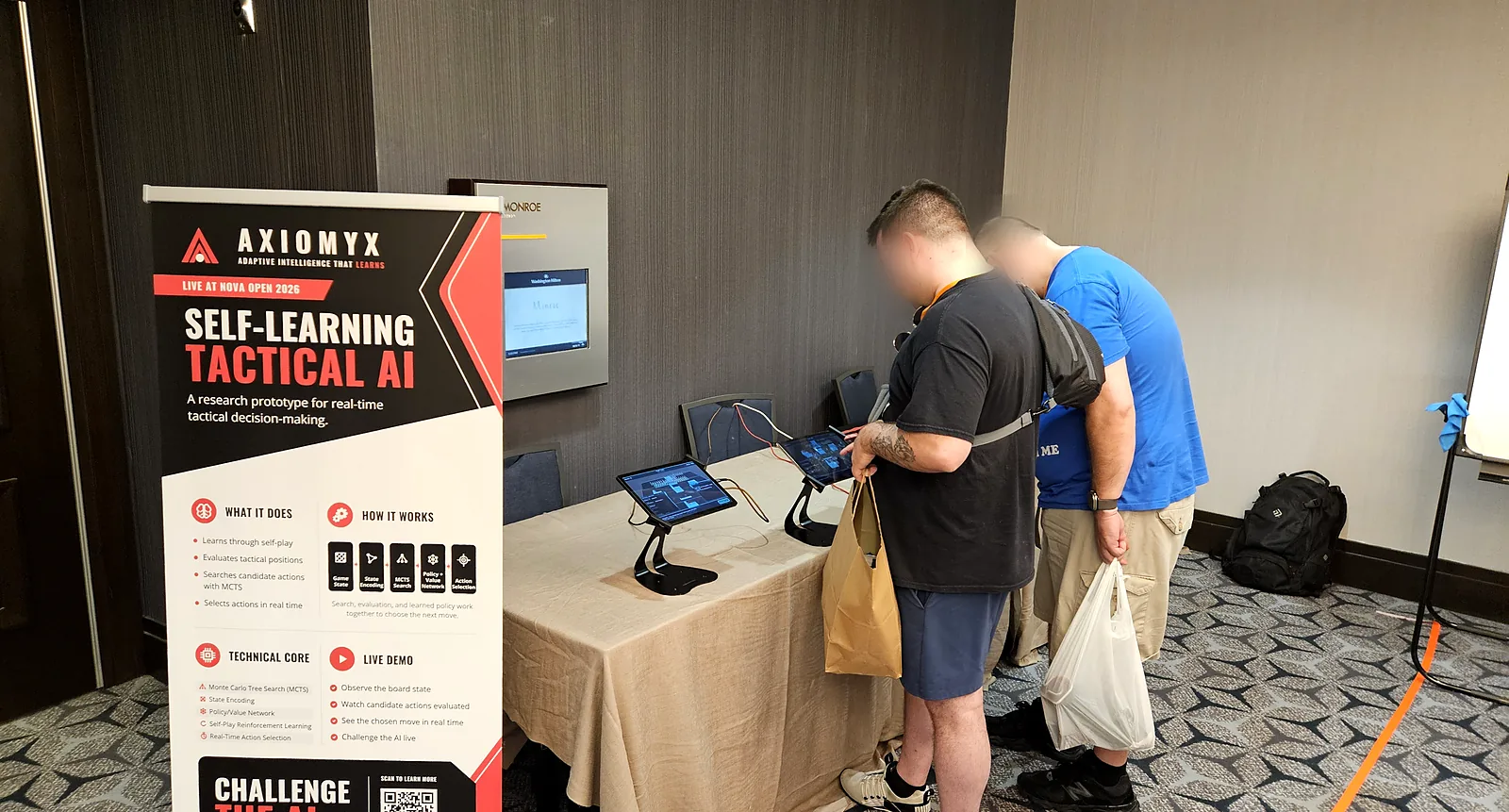
The agent held up its side of a full game. What players noticed was not that it made mistakes, but the kind of mistake it made.
It could: complete real games, make legal tactical decisions, interact with objectives, contest the board, execute movement and combat choices, and be there as a persistent opponent for as long as anyone wanted to keep playing.
What players consistently reported was that the current build played timid. It did not apply enough pressure. It was often too conservative, holding a position where a person would have pushed.
That is development feedback, not a verdict. It is also the kind of feedback that only comes from public play: a training run against itself will happily converge on a cautious policy and never tell you that a human finds it passive.
What it had learned
It valued the middle.
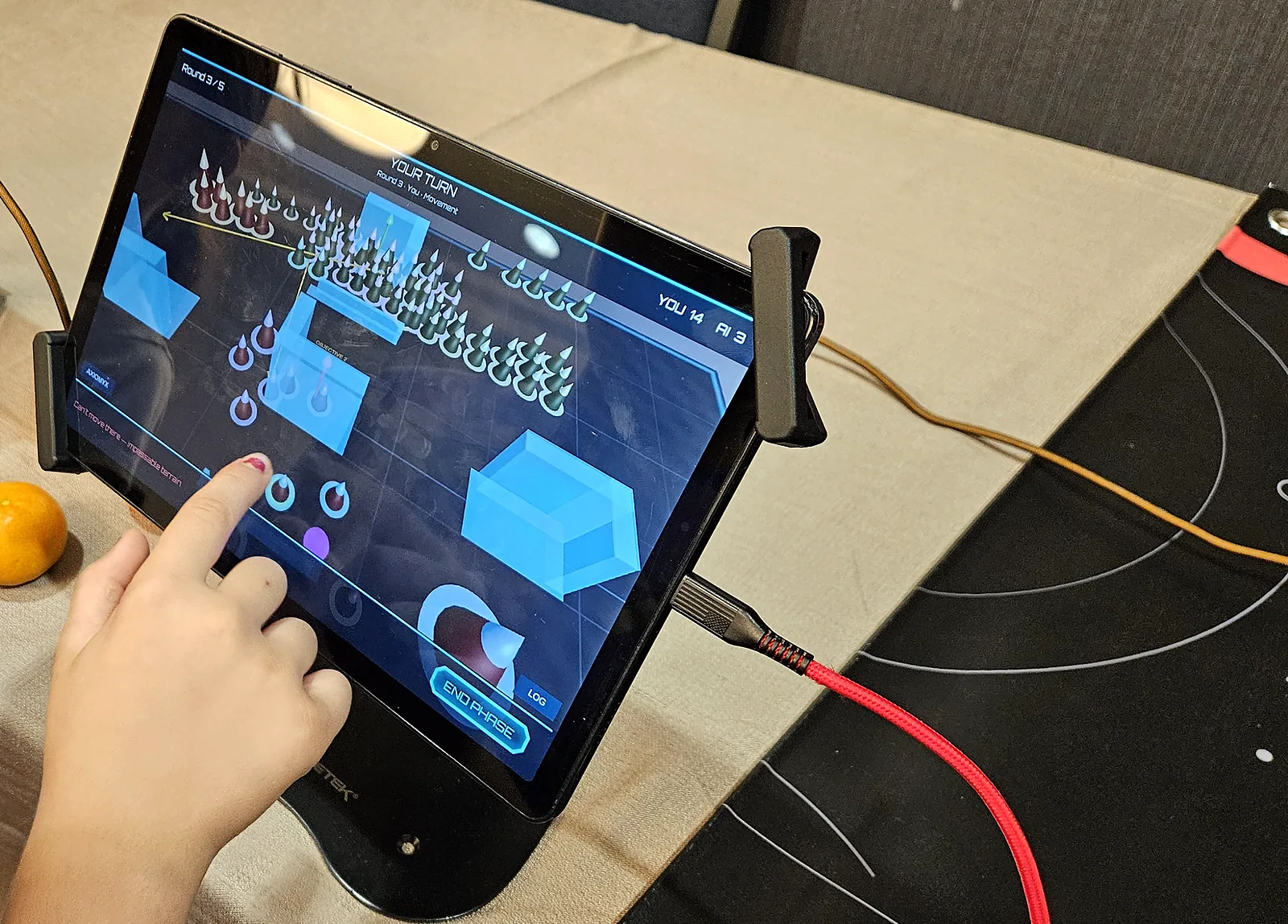
One behaviour showed up clearly across recorded games: the agent consistently contested the central objective and the terrain around it. It moved toward that space, it committed to holding it, and it treated losing it as worth reacting to.
Worth being careful about what that means. The agent did not form a concept of central control and it cannot explain the idea. Its learned policy assigned higher value to states where it held strategically useful central space, because across training those states more often preceded winning. The behaviour is visible in what it did, not in anything it said, and it never needed language to act on it.
That is the mechanism working as intended. Nobody wrote a rule saying the middle matters. It came out of outcomes.
Where the learning was incomplete
Legal action knowledge is not tactical understanding.
The clearest gap Nova exposed has nothing to do with the agent breaking the rules. It never did. It has to do with the relationship between two legal actions taken in sequence.
The charge example
A human player understands, without being told twice, that if a unit intends to charge then moving closer first shortens the distance the charge has to cover, and a shorter charge is more likely to succeed.
Axiomyx sometimes attempted charges from positions where a person would have fixed the geometry first. When the charge failed, the system had no concept along the lines of I should have moved closer before trying that. It had no such concept to fail to apply.
The agent knew that movement was legal. It knew that a charge was legal. What it had not yet learned is the higher-order relationship between them: that movement can be spent specifically to raise the probability that a later charge succeeds.
That relationship is not a rule to be looked up. It has to emerge from enough training examples where the sequence paid off and enough where it did not. This is exactly why a self-learning tactical system needs experience across sequences of decisions rather than across individually legal actions, and it is a good illustration of the difference between knowing the rules and playing well.
The result that mattered
Not that it won. That it could be played.
Axiomyx did not defeat expert players at Nova Open 2026, and this page is not going to suggest it did. Most players beat the current development build.
The result worth reporting is different. The agent had reached the point where a person could sit down and play a highly complex game against it, from start to finish, without another human opponent. That is the threshold Arena depends on, and it had been crossed.
It changed what people asked about. The conversation stopped being whether the machine was any good and became when a fuller version would be available. Players raised the same use repeatedly: practice when friends were unavailable, practice when the club was closed, extra repetitions against a specific situation, working on a matchup alone.
The strongest feedback was not about whether the current model was beatable. It was that being able to practise a complex game independently was already useful, and people wanted it before it was good.
Player feedback at the event was conversational. No formal survey was run and no structured feedback instrument was used, so nothing here is presented as a quotation or as a measured satisfaction result.
From Nova to Arena
What the event turned into.
Nova demonstrated the first piece of the Arena value proposition: a persistent tactical practice opponent that can complete a complex game with a human player. Everything after this is improving what that opponent does with its turn.
What is being worked on
Directly out of Nova
- Pressure, so the agent stops playing passively
- Tactical sequencing, including the charge geometry gap above
- Positional relationships across turns
- Longer-horizon planning rather than good next moves
What players asked for
Product direction
- Varied opponent behaviour rather than one profile
- Repeatable practice scenarios
- Decision telemetry surfaced to the player
- Analysis of a finished game, not just a result
This is what Arena is being built from.
Everyone who played at Nova is the reason it is being built the way it is.